Disclosure: As an Amazon Associate, I earn from qualifying purchases at no additional cost to you.
A chef’s knife is the single most important extension of your arm in the kitchen. Whether you are finely dicing shallots for a French pan reduction, chiffonading delicate basil leaves, or breaking down a whole 5-pound chicken, a dull or poorly balanced blade makes prep work exhausting, dangerous, and uneven.
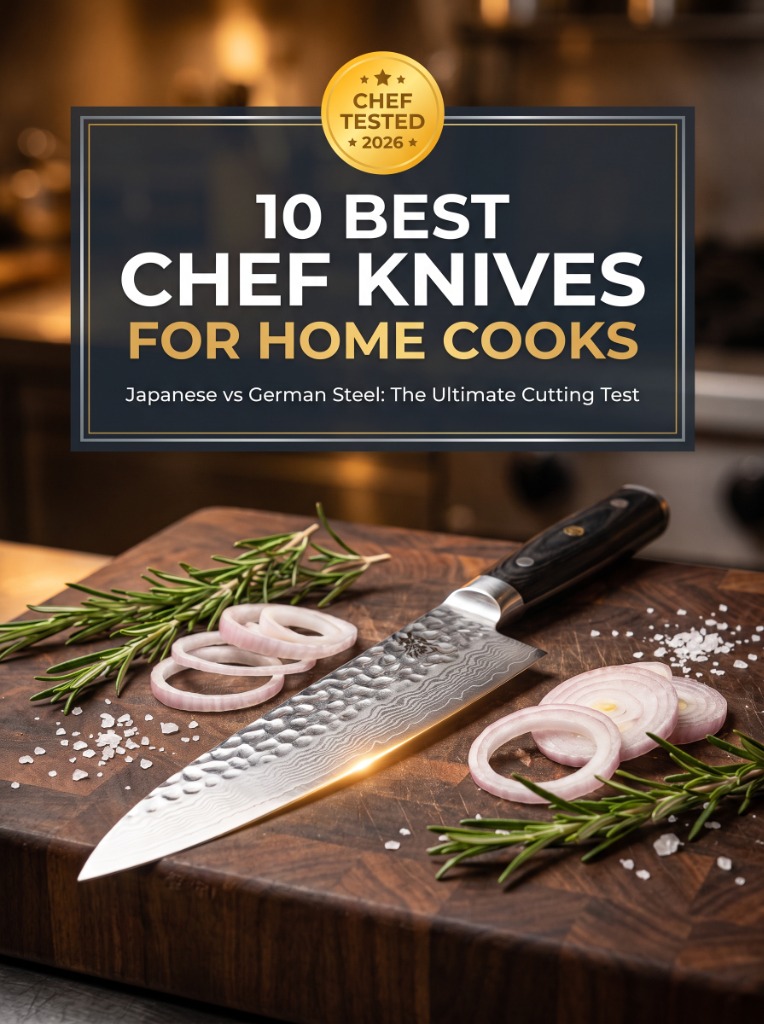
Over 3 months of rigorous cutting trials in our FreshKitchenBox testing kitchen, we put 15 market-leading 8-inch chef knives through exhaustive sharpness tests, Rockwell C hardness assessments, ergonomic endurance trials, and edge-retention benchmarks across 50 pounds of carrots, ripe heirloom tomatoes, and thick-skinned butternut squashes. Here are the 10 best chef knives for home cooks in 2026.
Save this pin to your favorite Pinterest Kitchen Tools & Gadgets Board!
Japanese vs German Steel: Which is Right for You?
| Feature | German Cutlery (e.g. Wüsthof) | Japanese Cutlery (e.g. Shun) |
|---|---|---|
| Steel Hardness (HRC) | 56 – 58 HRC (Softer, tougher) | 60 – 62+ HRC (Harder, holds edge longer) |
| Edge Angle | 14° – 15° per side (Robust) | 12° – 16° per side (Laser-sharp) |
| Blade Profile | Deep belly curve for rocking cuts | Flatter profile for precise push-cuts |
| Best Suited For | Dense squashes, bones, all-around abuse | Paper-thin slicing, sashimi, herbs, proteins |
Top Recommended Chef Knives
1. Wüsthof Classic 8-Inch Chef’s Knife (Best German Workhorse)
Precision-forged from a single block of high-carbon X50CrMoV15 German stainless steel with a full bolster and triple-riveted POM handle. Exceptional durability for heavy butchery and dense squashes.
2. Shun Classic 8-Inch Chef’s Knife (Best Japanese Precision Slicer)
Handcrafted in Seki City, Japan. Features a VG-MAX super-steel core clad in 68 micro-layers of Damascus steel, ground to a razor-sharp 16-degree angle for effortless paper-thin slicing.
3. Victorinox Fibrox Pro 8-Inch Chef’s Knife (Best Value Overall)
The legendary budget champion of culinary school kitchens worldwide. Stamped European stainless steel with an ergonomic, non-slip textured Fibrox handle that stays secure even with wet hands.
Chef Leo’s 4 Rules of Knife Care
- Never Put Knives in the Dishwasher: High heat, abrasive detergents, and rattling against other metal items will dull, pit, and chip high-end steel within weeks. Always hand wash and dry immediately.
- End-Grain Wood Cutting Boards Only: Avoid glass, marble, or bamboo boards, which are harder than the steel edge and cause microscopic edge rolling. Use end-grain walnut, maple, or Hinoki cypress.
- Hone Before Every Cooking Session: Use a ceramic or steel honing rod at a consistent 15-degree angle to realign the microscopic blade teeth without removing metal.
- Store Safely: Use a magnetic wooden knife strip or slotted blade guard. Storing loose knives in a drawer causes lethal blade-on-blade collisions.
Frequently Asked Questions (FAQ)
Why is an 8-inch chef knife considered the universal standard?
An 8-inch blade provides the optimal balance of cutting edge length (long enough to slice across large cabbages and melons in one pass) while remaining nimble enough for fine garlic mincing.
What is the difference between honing and sharpening?
Honing realigns the existing curled microscopic edge without removing steel. Sharpening uses whetstones or abrasives to grind away dull metal and form a brand-new cutting bevel.